How can I believe the Bible when it contains so much that’s obviously not true?
The Bible in its entirety is not true. It contains stories and statements that clearly aren’t true, and yet it also contains some of the most important truths of all. It’s like a gold-bearing stream. You have to sift through a lot of water and sand and grit and gravel and silt to get the gold. And there is lots of gold. You don’t abandon the entire stream, and all that gold, because of the sand and grit and gravel and silt. Not if you know how much gold is there.
People are mistaken who believe they have to accept everything in the Bible as literally true in order to faithfully follow the teachings of Jesus. People are also mistaken who believe that the Bible is just a collection of untrue fairy tales, or worse.
In one of the most important stories in the Bible, Jesus is talking to a Roman governor named Pilate. Pilate is trying to determine if Jesus has committed a crime. Jesus says to Pilate, “the reason I was born and came into the world is to testify to the truth. Everyone on the side of truth listens to me.” Pilate responds to Jesus by asking one of the most important questions in the entire Bible: “What is truth?”
What is truth?
How do you speak to a small child who asks about a complicated topic? How do you tell them the truth, as you understand it, when that truth is complex? “Where do babies come from?” “What makes something ‘alive’ — what is life?” “Which came first, the chicken or the egg?” Okay, that one’s easy: the egg came first, since chickens evolved from earlier species of egg-laying birds and reptiles. This is a great example of where the Bible’s explanation is no longer true. “How did animals evolve from other animals?” “Where did the world come from?”
When our daughter was almost two years old, we told her that she was going to have a baby sister, and that her baby sister was at that moment still growing inside her mommy’s tummy. Our daughter asked, “How did the baby get inside mommy’s tummy?” I said, “I put a seed in mommy’s tummy.” The next question came, “How did you put the seed in mommy’s tummy?” I should have anticipated this, but I hadn’t. I was pretty proud of my answer anyway, which aimed to be honest, understandable, and factual. I said, “I put my penis in mommy’s vagina and I squirted the seed in there.” Our little daughter turned to her mother and said, “Mommy, was that so gross that they had to give you sleeping medicine?”
It was hard not to laugh, but she was so earnest, and we didn’t want her to feel laughed at.
Was it the truth or not? Did I tell the truth or not when I spoke of a ‘seed’, instead of explaining about spermatozoa and ova and gametes and chromosomes and fertilization and zygotes? I don’t know what I would’ve said if she’d asked how the seed got inside my testicles or how the egg got inside mommy’s ovaries. How do you explain cellular biology to a small child who has only recently learned to speak? Part of what I said was true, part of it may have been untrue, or true in a sense but untrue in another sense or misleading.
Our knowledge and understanding of any subject has limitations, and our capacity for knowledge and understanding has limitations. You do your best to tell the truth, as you understand it, and you simplify the facts, as you understand them, if you want to teach someone who is less knowledgeable than you, or someone less developed in their capacity to understand what you think you know. Anyone knows this who has spent any significant time trying to teach anyone about anything.
The first parts of the Bible likely originated in oral traditions of Semitic language speakers in the ancient Near East during the Bronze and Iron Ages, over two thousand years ago. Were these people speaking truth or not when they uttered the following first lines of our modern Christian Bible?:
“In the beginning God created the heavens and the earth. Now the earth was formless and empty, darkness was over the surface of the deep, and the Spirit of God was hovering over the waters. And God said, “Let there be light,” and there was light. God saw that the light was good, and he separated the light from the darkness.”
Is this untrue today because it doesn’t explicitly mention the ‘Big Bang’, initial gravitational singularity, general relativity, forces and fields, quark-gluon plasma, energy congealing into subatomic particles, electrons, protons, charges, neutrons, electrostrong and electroweak forces, gravity, photons, electromagnetism, star formation, and so forth?
Honestly, I know those words, but do I really understand, even on the most primitive, childish level what any of that stuff really means? I do not. And I’ve been to school a lot. So how can I honestly say that the Big Bang theory of universal origin is ‘truth’? I cannot. I can only say that I believe it is part-truth, based on what some extremely intelligent, highly educated, mathematically-inclined humans think they know, for now.
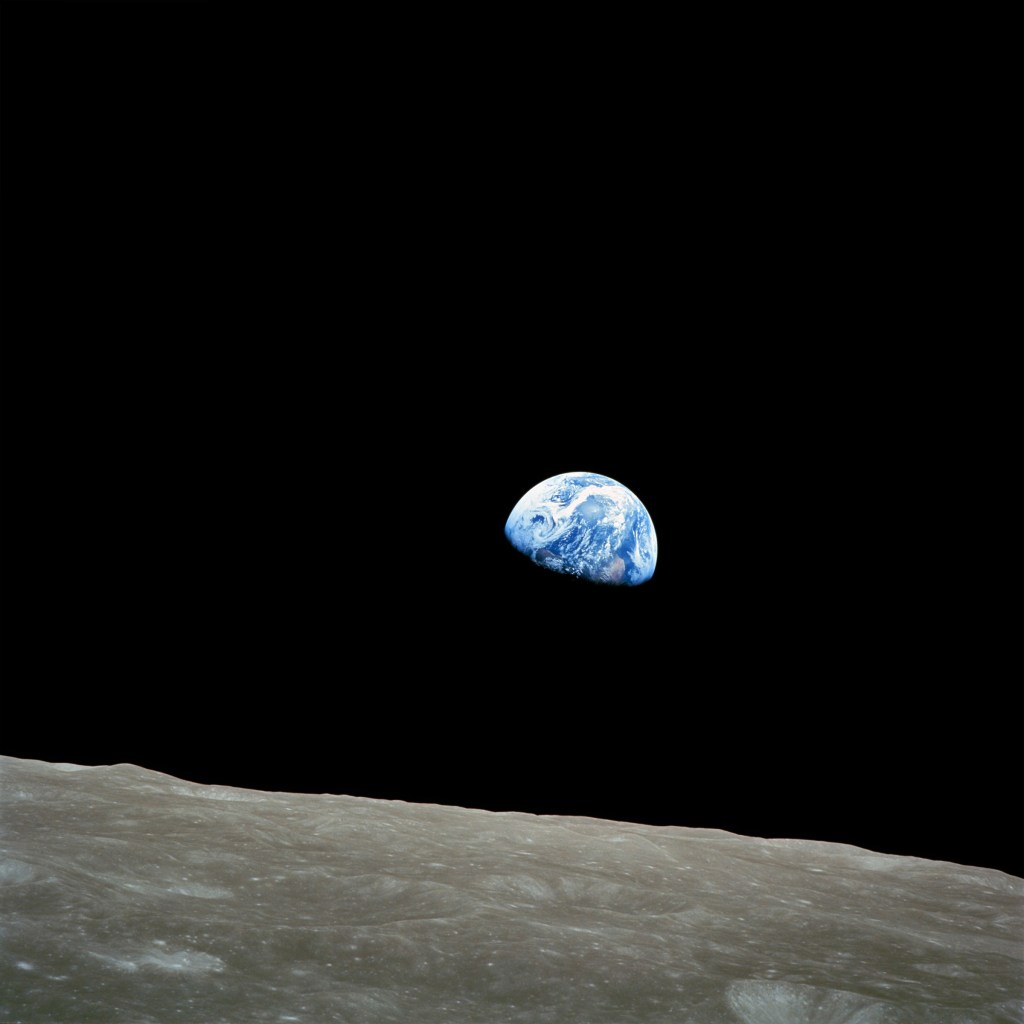
You could say that I should believe the science because of the miracles we’ve been able to perform with our scientific knowledge and theories and technology. Machines, electricity, trains, planes, automobiles, rockets to the moon and beyond, antibiotics, computers, nuclear reactors, nuclear bombs. Pretty strong evidence that something’s working. I agree, and that’s probably the main reason I do believe in science. ‘Seeing is believing.’ Jesus said essentially the same thing: “…even though you do not believe me, believe the works…”
Here’s my best effort to truthfully explain the Big Bang, as far as I think I understand it, which is not very far:
In the beginning… at least I think there was a ‘beginning’… but maybe there wasn’t a ‘beginning’, per se. Maybe there was no beginning, but rather there was always something, somewhere. I can’t explain how that would be. I can’t explain what that would be, nor ‘where’ ‘that’ would be. I guess we don’t really know the answer to that. Maybe one day we will. But anyway, in the beginning there was either something or nothing. The more I think about it, it seems like there would have to have been nothing, before there was something. How could you have something that was always there with no beginning? So maybe first there was nothing. But if there was nothing, then there was also no time while there was no thing, and so there was no time or not any time when there was nothing. Because time is defined by things and how they move or change relative to each other. So there can’t be any time without any things. So if there was no thing, then there was also no time, i.e., there was no time when there was nothing. So there must have always been something. Even if there ever was nothing, then after that came something. Something somehow came out of nothing. I can’t explain how that happened, nor how there might never have been nothing but rather that there could have always been something. Whatever. After that, whatever ‘that’ was (or wasn’t), people a lot smarter than I, people with a lot more knowledge and understanding of mathematics and physics and astronomy and astrophysics and subatomic physics than I, these extremely smart, knowledgeable people, whom I somehow trust, have calculated that there must have been a ‘Big Bang’. The Big Bang started after something came out of nothing (or from something that had always existed), and all the stuff that was something was crammed together into one tiny point of space that was so small that it wasn’t space at all. In fact, all the space in the universe was crammed into something with no size or volume whatsoever. So it was something (that came out of nothing) that was everything but it was so small that it was nothing. It was something so massive that it was everything, but so small that it was nothing. Then that thing that was everything and nothing exploded, or changed, or something. There was a Big BANG. But there wasn’t really a ‘bang’, per se, because there wasn’t any air or even anything remotely like air with particles and stuff for sound waves to travel through. So it was a huge BANG, but totally silent. We call it a ‘bang’, but that’s obviously misleading. I don’t know if you could see it or not, if any of it existed in the form of visible light. I’m guessing it did not yet exist in the form of visible light, and that would make it invisible, but what do I know? Not much, it turns out. And even if it wasn’t silent or invisible, there was nobody ‘there’ (where?) to witness it. Except God, if you believe in God. If a tree falls, and no one is there to hear it, does it make a sound? If God exists, and no one believes he exists, does he still exist? Then immediately after the Big Bang (whatever the hell that was) there were minuscule particles that found each other and made bigger particles. And some of the particles drew together, and other particles pushed apart. And there were giant clouds of particles. And particles clumped together to form stars and planets and galaxies and black holes. And the galaxies sped away from each other while the stars and planets and black holes inside the galaxies drew towards each other and ultimately fell into the black holes. And each of the black holes was so huge that it had shrunk to the size of nothing and was invisible. And I’ll stop there. That all makes perfect, clear sense, right? It must be true, somehow. I don’t really understand it, but I believe the people who said it. None of this is meant as a joke even though it sounds somewhat ridiculous. I’m being serious. And I have fourteen years of post-secondary education at reputable mainstream universities. I’m not just some illiterate ancient Semitic language speaker from the Bronze or Iron Age Near East.
Is the first part of the Bible creation story any more untrue than telling my daughter that I put a seed in her mommy’s tummy? Is it more untrue than my version of the Big Bang? It certainly is more poetic. Who wrote it, whom did they write it for, and why? I suspect the answers to these questions will always be only partially knowable.
God speaks to his children in languages they can hear and understand, in all times and places. That’s not to say that all of his children listen all of the time. In recent centuries, he’s been speaking to some of us through the languages of mathematics and physics and other sciences. Only a very small number of his children truly understand these languages. Isaac Newton, Albert Einstein, Stephen Hawking, and others of their kind are our high priests and priestesses of mathematics and physics and other natural sciences, and their mathematical languages, knowledge, observations, and deductive thinking clearly bring certain kinds of power. But these languages of modern science fail to answer some very important questions, like, “Who are we?” “Why are we here?” “Where are we going?” “How do we get there?” “How should we get there?” “What is good?” “What is evil?” “What is right?” “What is wrong?” “How can we responsibly manage and use the incredible technology our science has given us?”
It’s arguable that the languages of mathematics, physics, and other sciences have given us access to technologies for which we are grossly unprepared. Like kids who get a hold of their parents’ car keys or firearms, we have in our hands powerful tools, weapons even, but lack the wisdom to use them safely and well. Knowledge, science, and technology without wisdom are dangerous, destructive, and possibly evil. Our modern mathematical and scientific languages are far from the be-all and end-all.
If you read further in the Bible, past the first four verses, you quickly discover things that are clearly untrue. Things that don’t make any sense to us now, not even as poetic, symbolic representations of complex, abstract, or spiritual truths. Like children who grow up, go to school, see the world, learn, and learn to think, all humans rightly question the explanations and stories we were given when we were at an earlier stage of our development. My daughter went on to learn more about how babies are made, about sex and eggs and sperm and biology and genetics. She learned about evolution and natural selection. She learned that my description of “putting a seed in mommy’s tummy” was partially true, and also partially untrue, not the full story, and misleading in some important respects. For all the ‘creationists’ in the world who claim to reject the scientific theory of evolution, every simple farmer understands the reality of natural selection in day-to-day life and how humans use the knowledge of this truth to perform selective breeding of plants and animals. Science doesn’t have to be rocket science. Some of the old explanations and stories in the Bible are no longer credible or useful. But maybe we keep them around for various reasons. Maybe they help us remember who we are and where we came from, or what our ancestors believed, and how that shapes who we are today. Many Bible stories, both true and untrue, help us to understand Jesus’ teachings because they illustrate the historical, cultural, and religious context in which he lived and taught. Sometimes understanding the context of the teachings is necessary to understand the teachings themselves.
Maybe we also keep some of the stories simply because someone wrote them down, committed them to paper, then they were declared holy and sacred, and now they’ve become idols. False representations that may have once represented our best effort at describing reality, but are no longer true, and should be rejected and discarded. Blind devotion to scripture can become idolatry when the scripture no longer points to the truth, when the Word ceases to be the Living Word.
Here’s an example unrelated to the Bible: astrology. I was born between late February and late March in the second half of the 20th century. Believers of astrology will tell you that my astrological ‘sign’ is therefore that of Pisces. Pisces is my ‘Sun sign’. What this means is that at the time of my birthday each year, the position of the Sun in the sky is directly in front of the star constellation Pisces. You can’t see the star constellation Pisces behind the Sun because of the brightness of the sun which obscures the stars behind it in the daytime sky, but that’s what it means to be born under the Sun sign of Pisces. Except that it’s not true. It was true in the distant past, but it’s no longer true. In my lifetime in the latter half of the 20th century and the first half of the 21st century, in early March of every year, the Sun now aligns directly between Earth and the star constellation Aquarius. If you doubt me, look it up. But look it up in an actual, current, up-to-date astronomical table, not an astrological chart. The Sun in the first half of March was ‘in Pisces’ approximately 2,000 years ago, when ancient Babylonian and Greek astrologers such as Ptolemy worked it out and wrote it down. But the ancient Babylonian and Greek astrologers’ charts remained fixed on paper while the axis of the spinning Earth continued to precess in it’s 26,000 year cycle. The spatial relationship between the Earth and the Sun and stars beyond has shifted, and continues to shift. We write stuff down, because it was true at the time, but things change. The world changes. Our knowledge changes. Our capacity for understanding changes. If our devotion to the written word remains fixed even after the word is no longer true, then that word is dead, no longer the ‘living word’, and our blind, unwavering, rigid devotion to dead words becomes idolatry: worship of false, lifeless images of gods that aren’t really gods at all.
Jesus himself showed us how to throw out old beliefs and practices that no longer serve. He overturned centuries-old Jewish customs and traditions of his day such as not doing any work on the Sabbath (Matthew 12:12, Mark 3:1-6, Luke 6:6-11) and not eating foods traditionally considered unclean and taboo (Matthew 15:15-18, Mark 7:15). He accused religious leaders of putting their human traditions ahead of God (Mark 7:9). He taught, with words and parable stories and through his own actions, that sometimes we need to throw out old ideas and traditions and customs and conventions that no longer line up with truth as it continues to be revealed to us. He did this publicly even when it made him a target, leading to his arrest, public torture, and execution. People don’t like it when you challenge their attachment to their idols, their traditions, their fixed, rigid beliefs. They especially don’t like it if in doing so you are also challenging their power and wealth.
Jesus said, “I am the way and the truth and the life” (John 14:6) and “The reason I was born and came into the world is to testify to the truth. Everyone on the side of truth listens to me” (John 18:37).
Jesus also talked about one called the Devil or Satan or “the evil one” who represents the opposite of “the truth and the life”: “He was a murderer from the beginning, not holding to the truth, for there is no truth in him. When he lies, he speaks his native language, for he is a liar and the father of lies” (John 8:44).
For those drawn to it, the Bible bears an incredible wealth of spiritual ‘gold’, the signal, the important messages, the truth. It also carries a great volume of noise, the static, the clutter of part-truths and non-truths that has crept in over thousands of years of human transmission and translation and interpretation and distortion.
What is truth?
 ReligioMedici